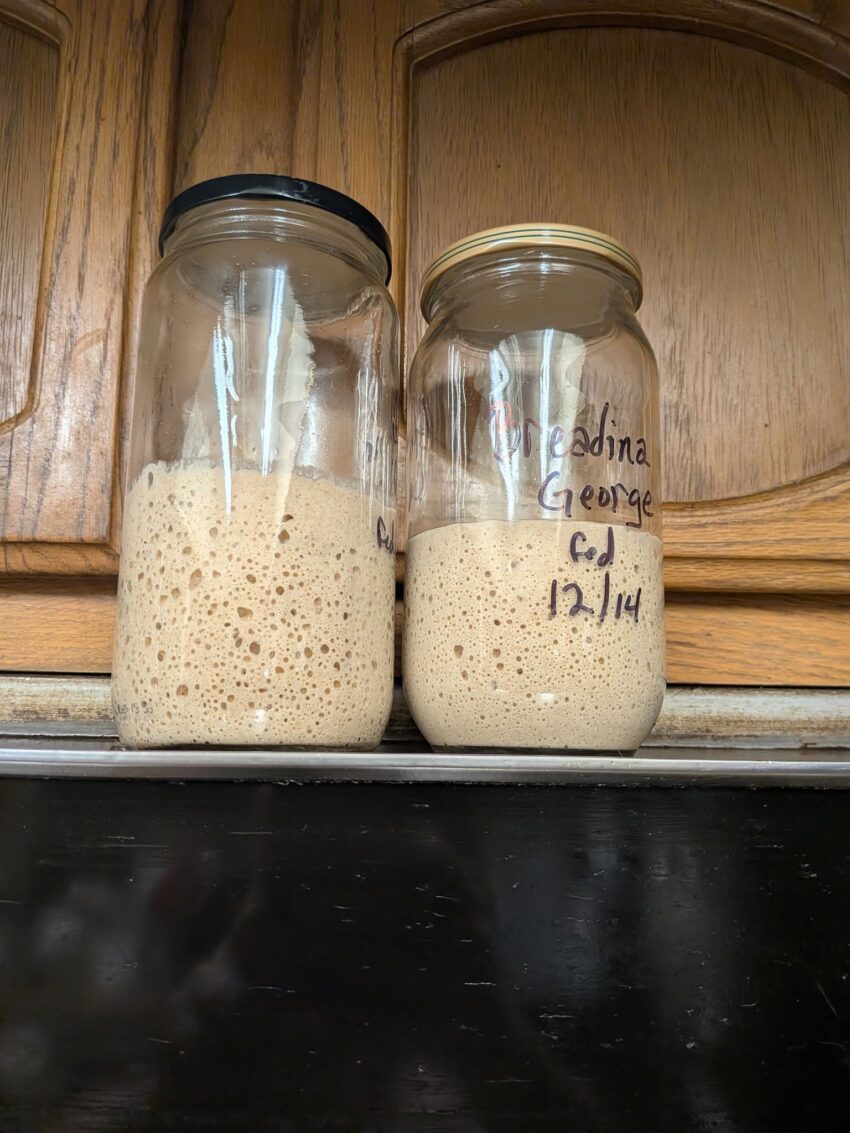
Here’s a complete guide to making and maintaining a Sourdough Starter, written in full detail 🥖✨
🥣 Sourdough Starter
A sourdough starter is a natural yeast culture used to make sourdough bread rise, giving it its characteristic flavor and texture.
⏱ Time Needed:
-
Active starter ready: 5–7 days
-
Maintenance: Daily or every few days
🧾 Ingredients
-
All-purpose or bread flour – ½ cup (50 g)
-
Water – ½ cup (50 g), room temperature
-
Optional: pinch of sugar to jump-start fermentation
Equipment:
-
Glass or plastic container (avoid metal)
-
Spoon or spatula
-
Kitchen scale (recommended for accuracy)
👩🍳 Step-by-Step Directions
Day 1: Start the Starter
-
Mix 50 g flour with 50 g water in a clean jar.
-
Stir until smooth and no dry flour remains.
-
Cover loosely (plastic wrap or lid slightly open) to allow air in but prevent contamination.
-
Leave at room temperature (20–25°C / 68–77°F) for 24 hours.
Day 2: Check and Feed
-
You may see bubbles or smell a slight tang—this is normal.
-
Discard half of the starter (≈50 g).
-
Add 50 g flour + 50 g water, mix well.
-
Cover loosely and leave at room temperature for 24 hours.
Day 3–5: Continue Feeding
-
Repeat discard + feed every 24 hours.
-
By day 3–5, the starter should:
-
Bubble actively
-
Double in size within 4–6 hours after feeding
-
Have a pleasant, slightly tangy smell
-
-
If it smells off (rotten), discard and start over.
Day 5–7: Ready to Use
-
Starter is ready when it doubles in size within 4–6 hours of feeding.
-
Perform the float test: drop a spoonful of starter in water—if it floats, it’s active and ready for baking.
🧑🍳 Maintenance Tips
-
Daily feeding at room temperature: Discard half and feed once a day.
-
Refrigerator storage: Feed, cover, and refrigerate if baking less often; feed once a week.
-
Always use clean utensils to prevent contamination.
-
Adjust water amount for desired consistency: should be thick but stirrable.
🔁 Variations
-
Whole wheat or rye flour: accelerates fermentation and adds flavor.
-
Hydration adjustment: more water → thinner starter, less water → thicker starter.
-
Flavoring: optional fruit puree or yogurt can speed up initial fermentation (day 1–2 only).
⚡ Tips for Success
-
Keep starter at consistent room temperature for best activity.
-
Avoid metal containers for long-term storage; use glass or food-safe plastic.
-
The discard can be used in pancakes, waffles, crackers, or muffins.